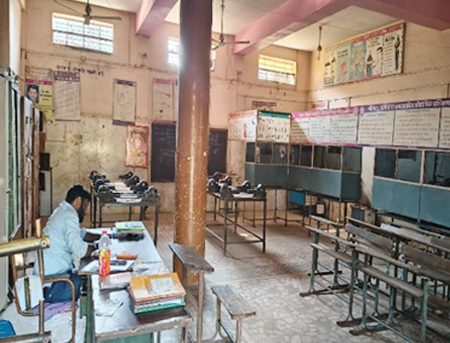
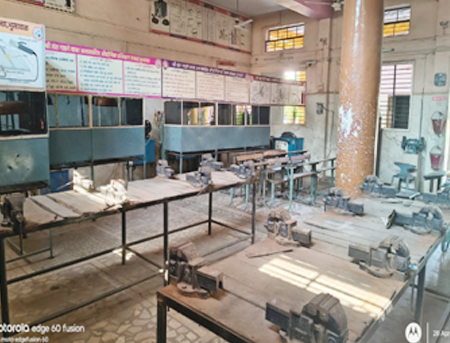
| |
|
Department - Welder :- |
|
|
|
|
During the one
year duration a candidate is trained on
subjects Professional Skill, Professional
Knowledge, Engineering Drawing, Workshop
Science& Calculation and Employability
Skills related to job role. In addition to
this a candidate is entrusted to under take
project work and extracurricular activities
to build up confidence. The broad components
covered under Professional Skill subject are
as below:
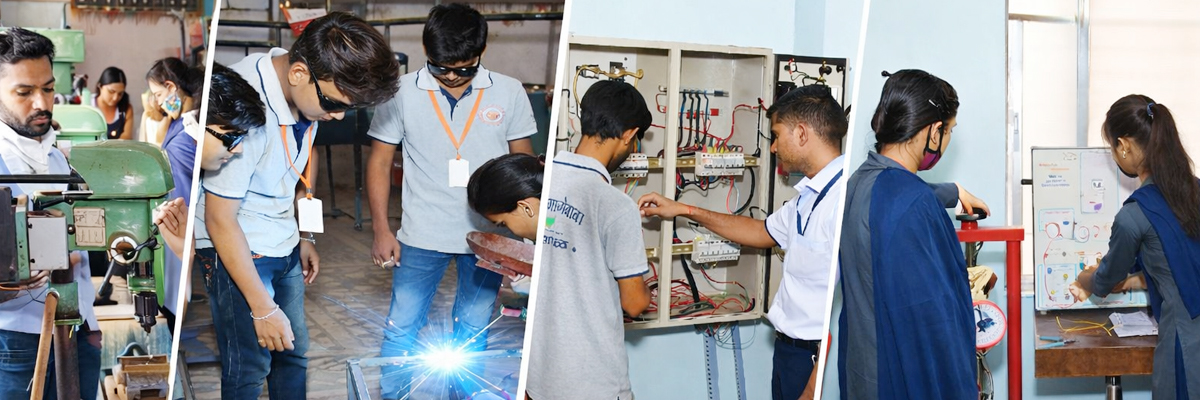
The practical skills are imparted in simple
to complex manner & simultaneously theory
subject is taught in the same fashion to
apply cognitive knowledge while executing
task. 2.Thesafety aspects covers components
like OSH & E, PPE, Fire extinguisher, First
Aid and in addition5S being taught. The
practical part starts with edge preparation
by hack sawing, filing and fitting followed
by Oxy Acetylene Welding & Brazing, Oxy
Acetylene Cutting, Shielded Metal Arc
Welding, Gas Metal Arc Welding, Gas Tungsten
Arc Welding and Spot Welding, Plasma Cutting
and Arc Gouging. These processes are widely
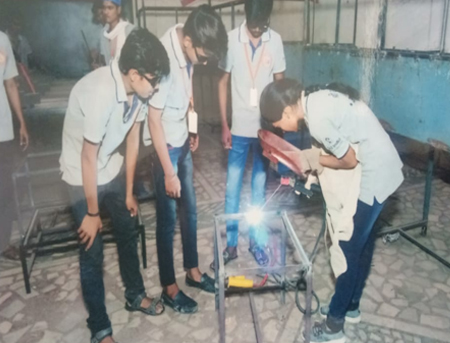
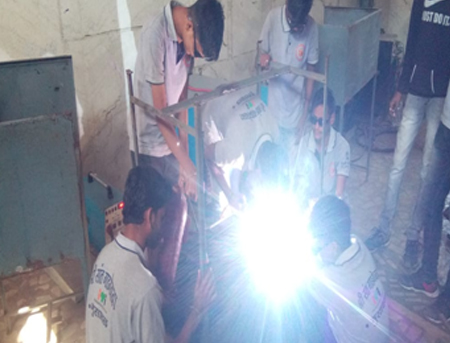
used in Industries. During the practice on
Welding / Brazing process, the trainees will
learn to read the job drawing, select the
required base metal and filler metals, cut
the metals by appropriate process, carry out
edge preparation, setup the plant and do
welding/Brazing on M.S, SS, Aluminum and
Copper in different positions. On completion
of each job the trainees will also evaluate
their jobs by visual inspection, and
identify the defects for further
correction/improvement. They learn to adapt
precautionary measures such as preheating;
maintaining inter-pass temperature and post
weld heat treatment for Welding Alloy steel,
Cast-iron etc. The Work Shop calculation
taught will help them to plan and cut the
required jobs economically without wasting
the material and also used in estimating the
Electrodes, filler metals etc. The Workshop
Science taught will help them to understand
the materials and properties, effect of
alloying elements etc. Engineering Drawing
taught will be applied while reading the job
drawings and will be useful in understanding
the location, type and size of weld to be
carried out. The professional knowledge
taught will be useful in understanding the
principles of Welding, Brazing and Cutting
process, use of jigs and Fixtures,
distortion and methods of control, selection
of consumables and to take precautionary
measures for storage and handling and apply
the same for executing the Cutting, Welding
and Brazing. The knowledge and practice
imparted on Destructive and Non-destructive
testing will be used in understanding the
standard quality of welds and to carry out
shop floor Inspection and test
inlaboratories. |
|
|
|
COURSE
INFORMATION - WELDER :
One project need to be completed by the candidates in a
group. In addition to above components the core skills
components viz., Workshop calculation & science,
Engineering-drawing, employability skills are also
covered. These core skills are essential skills which
are necessary to perform the job in any given situation.
GENERAL
The Directorate General of Training (DGT) under Ministry
of Skill Development &Entrepreneurship offers a range of
vocational training courses catering to the need of
different sectors of economy/ Labor market. The
vocational training programs are delivered under the
aegis of Directorate General of Training (DGT).
Craftsman Training Scheme (CTS) with variants and
Apprenticeship Training Scheme (ATS) are two pioneer
schemes of DGT for strengthening vocational training.
Welder trade under CTS is one of the most popular
courses delivered nationwide through network of ITIs.
The course is of one-year duration. It mainly consists
of Domain area and Core area. In the Domain area (Trade
Theory & Practical) imparts professional skills and
knowledge, while the core area (Workshop calculation &
Science, Engg. Drawing and Employability Skill) imparts
requisite core skills, knowledge, and life skills. After
passing out the training program, the trainee is awarded
National Trade Certificate (NTC) by DGT which is
recognized worldwide. Trainee broadly needs to
demonstrate that they are able to: |
|
|
-
Read &
interpret technical
parameters/documentation, plan and
organize work processes, identify
necessary materials and tools;
-
Perform
tasks with due consideration to safety
rules, accident prevention regulations
and Environmental protection
stipulations;
-
Apply
professional knowledge, core skills &
employability skills while performing
the job, and repair & maintenance work.
-
Check the
job/ assembly as per drawing for
functioning identify and rectify errors
in job / Assembly.
-
Document
the technical parameters in tabulation
sheet related to the task undertaken.
|
|
PROGRESSION PATHWAYS : |
|
|
- can
join industry as Technician and will
progress further as Senior Technician,
Supervisor and can rise up to the level
of Manager.
- can
become Entrepreneur in the related
field.
- can
join Apprenticeship programme in
different types of industries leading to
National Apprenticeship certificate (NAC).
- can
join Crafts Instructor Training Scheme (CITS)
in the trade for becoming instructor in
ITIs.
|
|
|
|
|
|
Key Aspects of
the Welding Trade |
|
Assessment will be evidence based comprising
the following: |
|
|
|
- Common
Techniques: Welders use specific
techniques based on material, including
Arc Welding, MIG (Metal Inertial Gas)
Welding, TIG (Tungsten Inertial Gas)
Welding, and Gas Welding.
-
Industries: Major employers include
shipbuilding, automotive, aerospace,
construction, defense, and
maintenance/repair sectors.
-
Training & Certification: Many
technicians train at Industrial Training
Institutes (ITIs) and receive a National
Trade Certificate (NTC). Programs often
focus on 1G–6G welding positions, with
certifications available through
organizations
- Safety
Requirements: Strict adherence to safety
protocols is required, including the use
of Personal Protective Equipment (PPE).
- Career
Potential: Experienced welders can earn
high incomes, with specialized,
experienced, or travel-based roles
sometimes exceeding
|
|
- Job
carried out in labs/workshop
- Record
book/ daily diary
- Answer
sheet of assessment
-
Viva-voce
-
Progress chart
-
Attendance and punctuality
-
Assignment
-
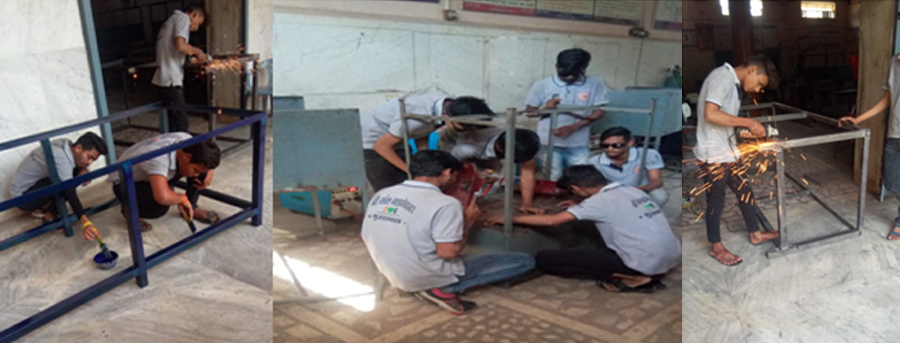
Project work
|
|
|
 |
|
|
|
Name of the Trade |
Welder |
|
Trade Code |
DGT/1004 |
|
NCO - 2015 |
7212.0100, 7212.0200, 7212.0700,7212.0400, 7212.0500,7212.0105,
7212.0303, 7212.0111, 7212.0402 |
|
NSQF Level Level |
– 4 |
|
Duration of Craftsmen |
Training One year (1600 Hours) |
|
Entry Qualification |
Passed 8th class examination |
|
Minimum Age |
14 years as on first day of academic session. |
|
Eligibility for PwD |
LD, LC, DW, AA, DEAF, HH |
|
Unit Strength (No. Of Student) |
20 (There is no separate provision of supernumerary seats) |
|
|
|
|
|
|