| |
|
Department - Fitter :- |
|
|
|
|
During
the two-year duration a candidate is trained
on subjects Professional Skill, Professional
Knowledge, Engineering Drawing, Workshop
Science & Calculation and Employ ability
Skill related to job role. In addition to
this a candidate is entrusted to make/do
project work and Extra Curricular Activities
to build up confidence. The practical skills
are imparted in simple to complex manner &
simultaneously theory subject is taught in
the same fashion to apply cognitive
knowledge while executing task. The
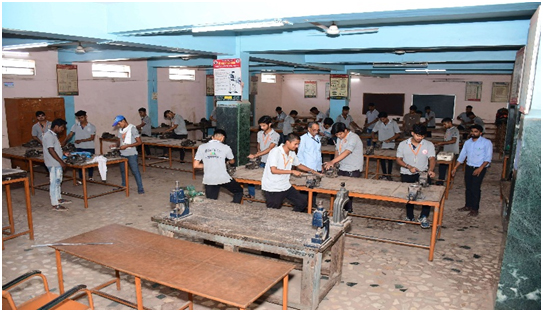
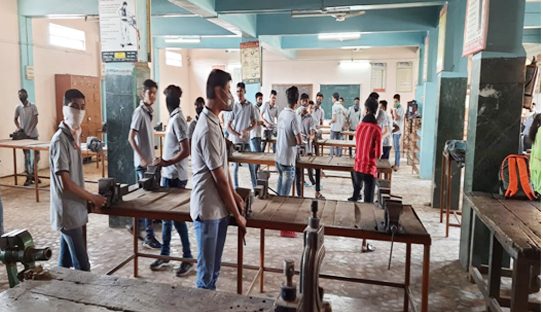
practical part starts with basic fitting
with tolerance level ± 0.5mm and finally to
± 0.02mm and angular tolerance from 1° to10′
at the end of the course. The broad
components covered under Professional Skill
subject are as below
FIRST YEAR:
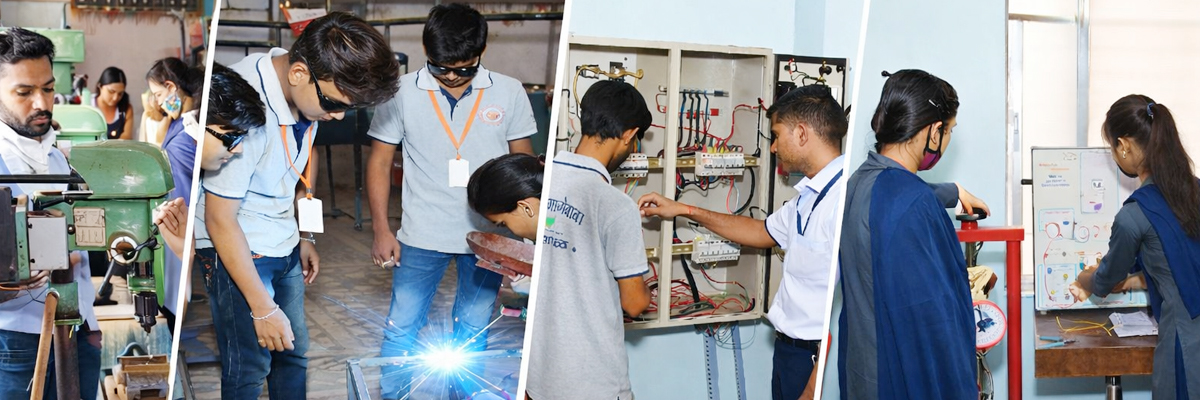
The practical part starts with basic fitting
in the beginning and the candidate also
imparted training on allied trades viz.,
Sheet Metal, Welding (Gas & Arc) which leads
to multi-skilling. In the basic fitting the
skills imparted are sawing, filing, marking,
chipping, measurement, riveting, soldering,
brazing, drilling and observation of all
safety aspects is mandatory. The accuracy
achieved is of±0.25 mm. The safety aspects
cover components like OSH & E, PPE, Fire
extinguisher, First Aid and in addition 5S
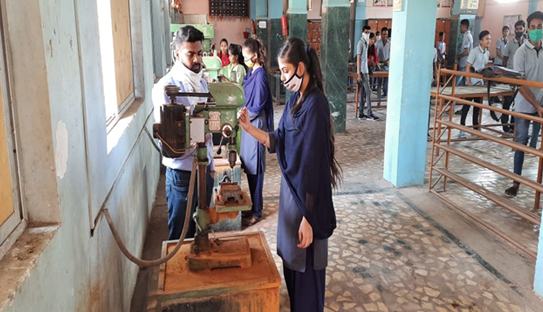
being taught. Different drilling operations
(through, blind, angular), reaming, offhand
grinding, tapping, dieing, different fits
viz., sliding fit, etc., scraping, fastening
(nuts & bolts, riveting, studs, screws,
etc.,). The accuracy achieved is of± 0.04 mm
and angular accuracy to 30minutes.Different
turning operations on lathe (step, grooving,
chamfering, drilling, boring, knurling
&threading), simple repair, overhauling and
lubrication work on machine are being taught
in the practical.
SECOND YEAR:
Power tool operation, different complex
assembling and fitting, fastening, lapping,
making gauges, pipe works and pipe joints,
Dismantling, overhauling& assembling valves
are covered. The accuracy achieved is of an
accuracy of ± 0.02 mm & 10 minutes. Making &
using drill jigs, making of critical
components, repair & maintenance of power
transmission system, making of template
&complex gauges, identify different
Pneumatic &hydraulic components and circuit
construction, repair & maintenance of
machinery like lathe, drill, grinding, bench
drilling, Inspection of Machine tools,
Accuracy testing of Machine tools and
erection of simple machines are being
performed as part of practical training.
Professional Knowledge subject is
simultaneously taught in the same fashion to
apply cognitive knowledge while executing
task. In addition components like Physical
properties of engineering materials,
Interchangeability, Method of expressing
tolerance as per BIS Fits, |
|
|
|
COURSE
INFORMATION - |
|
|
|
Different types of iron, properties and uses, special
files, honing, Metallurgical and metal working processes
such as Heat treatment, the various coatings used to
protect metals, different bearing, working material with
finished surface as aluminum, duralumin and stainless
steel, topics related to non-ferrous metals, Method of
lubrication are also covered under theory part. Total
two projects need to be completed by the candidates in a
group. In addition to above components the core skills
components viz., Workshop calculation & science,
Engineering drawing, employability skills are also
covered. These core skills are essential skills which
are necessary to perform the job in any given situation. |
|
|
|
|
|
|
|
GENERAL |
|
|
|
The
Directorate General of Training (DGT) under Ministry of
Skill Development & Entrepreneurship offers a range of
vocational training courses catering to the need of
different sectors of economy/ Labor market. The
vocational training programmes are delivered under the
aegis of Directorate General of Training (DGT).
Craftsman Training Scheme (CTS) with variants and
Apprenticeship Training Scheme (ATS) are two pioneer
schemes of DGT for strengthening vocational training.
Fitter trade under CTS is one of the most popular
courses delivered nationwide through network of ITIs.
The course is of two years duration. It mainly consists
of Domain area and Core area. The Domain area (Trade
Theory & Practical) impart professional skills and
knowledge, while Core area (Employability Skills)
imparts requisite core skills, knowledge and life
skills. After passing out of the training program, the
trainee is awarded National Trade Certificate (NTC) by
DGT which is recognized worldwide. Candidates broadly
need to demonstrate that they are able to: |
|
|
- Read & interpret
technical parameters/document, plan and organize
work processes, identify necessary materials and
tools;
- Perform task with
due consideration to safety rules, accident
prevention regulations and environmental protection
stipulations
- Apply professional
skill, knowledge, core skills & employability skills
while performing jobs.
- Check the
job/assembly as per drawing for functioning,
identify and rectify errors in job/assembly.
- Document the
technical parameters related to the task undertaken.
|
|
PROGRESSION
PATHWAYS: |
|
|
- Can join industry
as Technician and will progress further as Senior
Technician, Supervisor and can rise to the level of
Manager.
- Can become
Entrepreneur in the related field.
- Can appear in 10+2
examination through National Institute of Open
Schooling (NIOS) for acquiring higher secondary
certificate and can go further for General/
Technical education.
|
|
Key
Aspects of the Fitter Trade :- |
|
|
|
Training & Curriculum: The
course covers trade theory and practical applications,
including marking, filing, sawing, drilling, and
tapping. |
|
|
|
Key Skills: |
|
|
- Precision
Measurement: Using calipers, micrometers, and
gauges.
- Mechanical
Maintenance: Dismantling, repairing, and
reassembling machinery components (bearings, gears).
- Drafting/Blueprint
Reading: Interpreting technical drawings for
fabrication.
- Pipefitting &
Welding: Handling pipes and basic welding works.
|
Career Opportunities:
Fitters are employed in public and private sectors,
including heavy engineering, oil & gas, defense,
railways, and manufacturing units.
Duration & Certification: It is typically a
2-year course, resulting in a National Trade Certificate
(NTC). |
|
|
|
Types of Fitter Roles : |
|
|
- Mechanical Fitter:
Assembles and repairs industrial machines.
- Pipe Fitter:
Installs and maintains high-pressure pipes and
hydraulic systems.
- Bench Fitter:
Specializes in small-scale precision assembly and
finishing on a workbench.
- Fabrication
Fitter: Assembles metal structural components.
|
|
|
|